
Input isn’t Impact
Lately, I’ve been sitting with a heavy but persistent feeling: it’s too much. Between the news, family, work, etc. I’ve been fantasizing about moving to a secluded farm and just hiding out for a while. Anyone else?
We are living in a time of constant input. News alerts, emails, social feeds, leadership advice, parenting guidance, productivity strategies. There is always something else we could be reading, watching, doing, or worrying about.
“I want to be informed!”
“There’s more I should be doing!”
But, the result isn’t that we feel more informed or able to do more. Often, it’s the opposite. We feel scattered, overstimulated, and unsure of what we should do next. The problem isn’t that we care. It’s that we’re confusing more input with more impact.
We are filling every available mental and emotional space with more inputs, but giving next to no space for processing what it means and what we can actually do about it.
When I start to feel overwhelmed, one practice I return to is Stephen Covey’s idea of circles of influence. At its core, it’s a simple distinction between what we can control or influence, and what concerns us but ultimately sits outside our control.
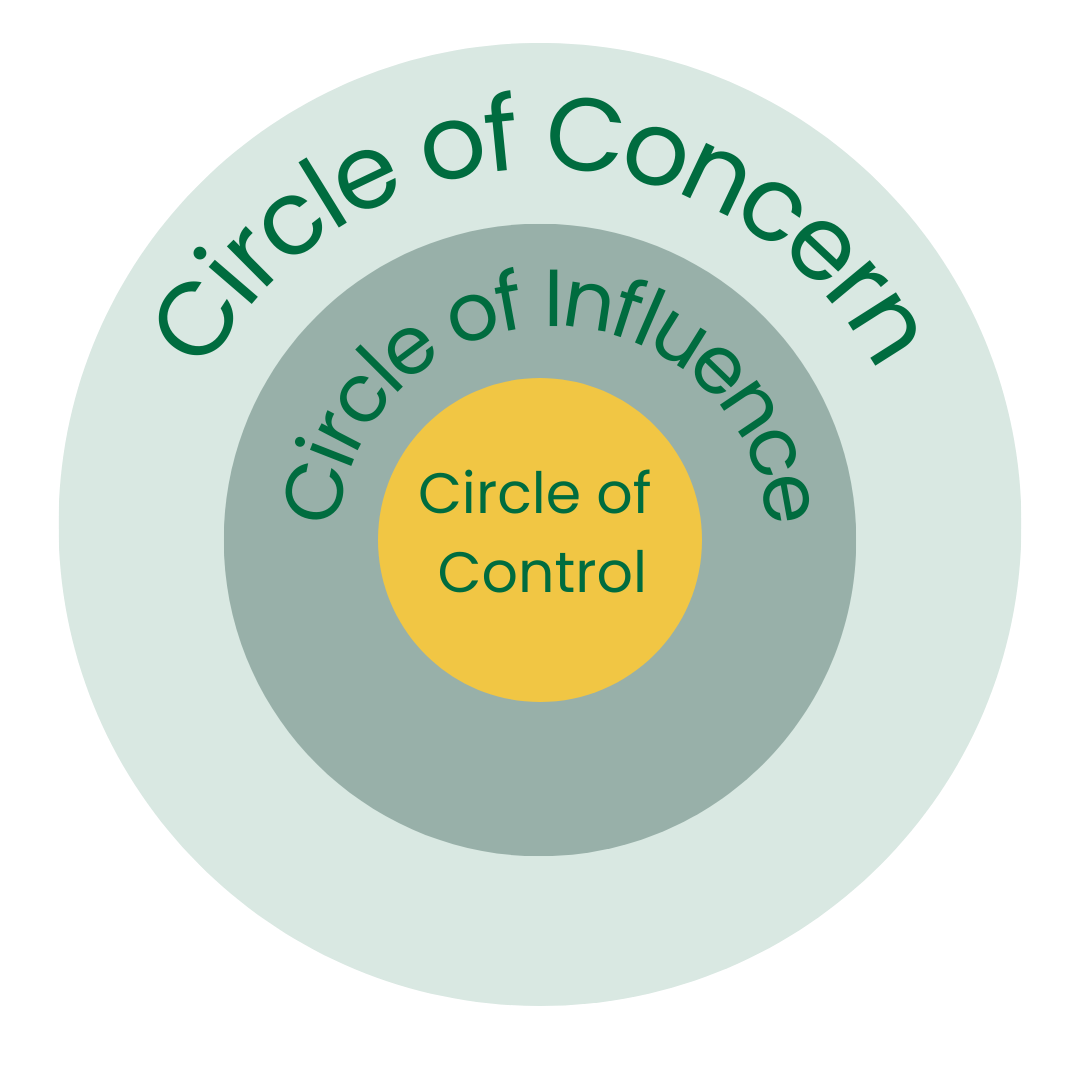
Circle of Control – Things fully within our control, such as our thoughts, feelings, and decisions.
Circle of Influence – Things we influence through our actions and choices, such as relationships and community.
Circle of Concern – Things we may be affected by or feel for, but do not directly influence or control, such as natural disasters, global politics, or even the conflict or relationships of others.
When everything feels like too much, it’s usually a sign that my energy has drifted far outside my circle of influence. I’m worrying about outcomes I can’t dictate. I’m trying to solve problems that aren’t actually mine to solve. I’m absorbing information without a clear or meaningful way to act on it.
Covey explains that when we’re focusing too much of our energy on the Circle of Concern, we feel powerless and reactive. When we shift that focus inward toward what we can influence, we feel more empowered and impactful.
Naming that feeling can be grounding. It helps me come back to a steadier question: what is one small, meaningful thing that is actually within my influence right now? For me, that often looks like realizing I can’t control the news cycle or other people’s decisions, but I can control how much I consume, where I put my attention or my money, and how I show up for the people directly in front of me.
I want to be honest, though. This practice doesn’t magically make overwhelm disappear. There are days when the world still feels like too much, when perspective is hard to access, and when naming what I can control doesn’t immediately settle my nervous system.
But more often than not, it reminds me that I don’t have to carry everything at once, and that not every concern requires my immediate action. Taking in less, intentionally, isn’t about disengagement; it’s about choosing where the limited energy I have will actually make a difference.
If you’re feeling pulled in too many directions right now, you might consider reflecting on a few questions:
What am I currently giving energy to that sits outside my circle of influence, and what would it look like to loosen my grip on one of those things, even slightly?
Where might doing less actually create more clarity or calm in my day or week? What is one small way I could create that space?
What is one action, rooted in what I can control, that would feel grounding rather than draining right now?
It’s worth reminding ourselves that we don’t need to do everything, or do it all today.